|
MARCH 30, 2009
Good Vibrations
BY ROBIN
TOLLESON
|
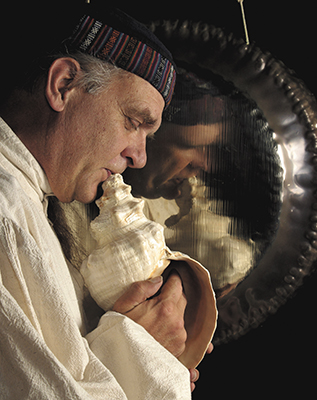
Richard Hite
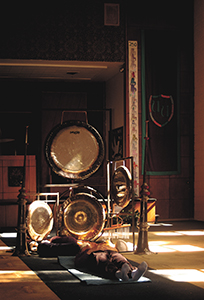
approaches the three large gongs, kneeling reverentially
and nestles in among the bells, conch shells, Tibetan temple
horns and goat horns on the floor. He reaches up with a
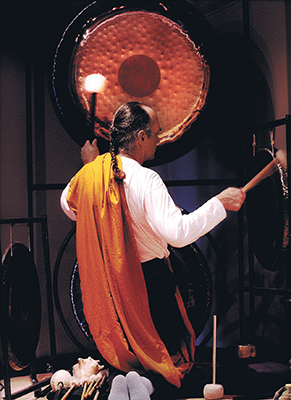
mallet, and with a feathery touch begins priming one gong
with an arcing motion across the textured brass. The result
is a continuous low drone that resonates deep into the skin.
With his other hand he gives a second gong a glancing blow,
the direct tone weaving into the undulating tones of the
first. "Playing the instrument regularly is as much a practice
of my own spiritual path as anything else I do," says the
57-year-old Hite. "For me, it's a meeting with God, it's
an expression of gratitude. I had a God experience the first
time I heard one." Hite and his partner
of 20 years, physical therapist Susan Thompson, are living
at the Embracing Simplicity Hermitage in Hendersonville
while preparing for a concert at the Light Center in Black
Mountain on April 25. "We don't have a plan after that,"
he says with astounding faith. This former clinical psychologist,
who until recently rejected the notion of himself as a musician,
is now considering exploring the Los Angeles music scene
with his mantra of healing as entertainment, or as he calls
it, "entertrainment." An accomplished martial artist, Hite
suffered a severe back injury in the mid-1970s. "It wasn't
just a physical injury, it was an identity shift," he says.
He began attending yoga classes, and heard his first gong
in 1977. "After a routine they brought it out and just banged
it, just made it roar," he recalls softly. "That had a very
profound effect on me. At
the same time I knew that you didn't have to beat it to
get it to do what it needed to do. You don't beat the singers
to make them sing better."
The next day he bought a pair of timpani mallets. "I went
back to the ashram and asked them to let me play the gong.
And with the little mallets I got it to sing in the higher
overtones. It sang, and that was it - I was hooked. I had
to find out more."
|
 |
Hite earned his masters degree in
psychology and put it to use leading mind-body seminars, directing
corporate training and opening a yoga center in Clearlake, Texas
in 1987. In 1989, after a devastating explosion at a petroleum
plant in Pasadena, Texas, Hite took his therapeutic yoga to an
in-patient trauma center at a hospital there. From the beginning
the gongs were part of his treatments. "Early on, I got to see
how just one 24-inch Paiste symphonic gong could effect EEG response,
brain wave activity response. When you added that to the effects
of everybody stretching and breathing and relaxing, it triggered
healing experiences, even from the very first group. And sometimes
it was just miraculous.
"What I knew in the beginning was that by keeping the center tone
going with a basic rhythm pattern, I could do the same thing that
a shaman was doing with a drum beat, and through entrainment get
the brain wave to go into a higher alpha state, six and a half
to nine cycles a second, which is six and a half to nine beats
a second. With a single gong that beat tone effect was really
effective, but then when I got two gongs everything took off.
When I started bringing the 30-inch gong with the 24-inch gong
to the hospital, I found that by adjusting the angle of the faces
in relation to each other, you control the frequency of the beat
tone effect that you get from the two gongs. And then you could
very precisely control the entrainment process."
|
|
Hite noticed improved circulation
in diabetic patients as well. "Two notes on that 30-inch
gong would override capillary constriction and start wound
healing immediately. I had an idea that the intense resonance
of the deep tones would help
them relax. What I didn't know was that by stimulating
the skin so much that it would interfere with the constriction
that was part of the trauma process, and cause relaxation
to the extent that it does, but its awesome."
Hite offered stress reduction seminars for NASA engineers
and was invited to a class of Harvard Medical School students.
"I'd start playing the gongs gently with a large mallet,
creating the deep resonant tones off the centers of each,
without hitting either one of them hard enough to go into
the splash. The 'whoa whoa whoa whoa whoa' effect going
on in the room was more felt than heard. I'd be talking
to them about stress reduction or some other thing, but
the talk is just the dog and pony show. After ten minutes
of that center tone, pain has gone away and everybody
is in a very profoundly relaxed state."
When Hite's hospital program lost funding in 1999, he
and Susan Thompson bought a motorhome and left Texas.
He planned to use some time to write a book about his
clinical work. Meanwhile, Hite continued to get offers
to perform with his gongs at
|
the Vancouver Sacred Music Festival,
the Seattle Sacred Music Festival, Institute of Noetic Sciences
conferences in Vancouver, B.C. and at Agape Church in Los Angeles.
Hite was performing with, and feeling validation from other musicians.
"They were telling me this is music,
and I'm realizing that maybe my self concept just isn't right.
That maybe I need to let go of who I thought I had professionally
created, because it's just surface anyway. And maybe there's something
else going on here that I need to pay attention to."
At one conference, Hite was asked to play for a group of visiting
Tibetan lamas. "After I played, one of them said, 'It was like
a friend calling me to meditate.'"The leader of the group
was a Tibetan physician, and when he learned that I play the gongs
in hospitals, they proposed to do a blessing. They sat in front
of the gongs and sang a prayer with that deep tonal chanting.
With their voices they made the gongs sing back, and that was
awesome. And it gave me a sense of 'Okay, now what?' I've got
the science behind it, and now I've got the blessings from the
traditional practitioners.
|
As we're sitting there Susan looks at me
and says, 'You know, if all people have to do now is come,
lay down and listen to you play to experience healing, who
are you not to do that?'
I had no answer."
"Initially I played to please me" Hite admits. "I felt something
happen psychically and spiritually the first time I heard
a gong played. I was different after I heard it, and I wanted
to explore that."
The reason the Tibetan lamas play the gongs in their monasteries,
Hite says, is because they believe the gongs call in angels
and other benevolent spiritual beings. "They believe that
they like the overtones. When we get the overtones going,
and the beat-tone effect with the overtones, people go into
very deep brain states, high alpha, high theta states. That's
what we're measuring. You can't measure consciousness but
you can measure correlates. The alpha and theta patterns
that the music brings about are patterns associated with
long-term meditation, patterns associated with immune system
functioning, patterns associated with wound healing. If
you can shape the energy of the heart signal, so that the
energy going to the heart is always telling the heart that
it's okay to heal, then for a cardiac patient that music
can be live saving. And the way to reach more people is
to make it entertaining and make it accessible."
|
|
reprinted from Bold
Life
|